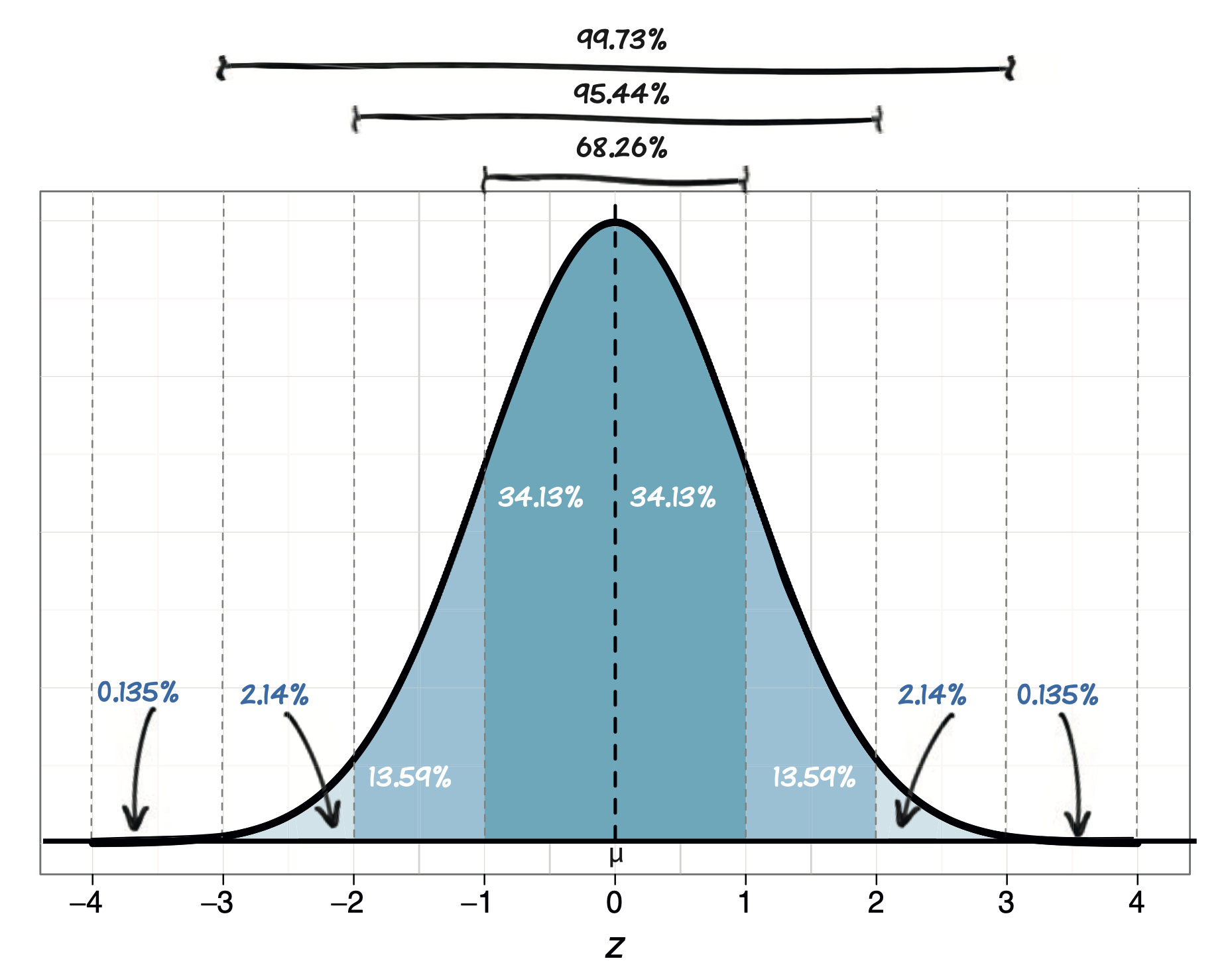
Z-score measures how many standard deviations a data point is from the mean.
Purpose: To understand relative position within a distribution.
\[z = \frac{x - \mu}{\sigma}\]
\(z\) = standardized score
\(x\) = data point
\(\mu\) = mean value
\(\sigma\) = standard deviation
If the z-score is positive, the data point is above the mean; if negative, it’s below the mean.
Z-scores provide a standardized method to:
Compare data points across distributions.
Detect outliers.
Assess relative performance.
Probability is a way to talk about how likely something is to happen.
It’s like making a guess, but with some rules and numbers to help us know how good our guess is.
Probability is a number between 0 and 1
0 means it will not happen (impossible).
1 means it will definitely happen (certain).
In-between numbers mean “maybe.”
A probability between \(0.5\) to \(1\) means that an event is more likely to happen than not, and the closer to \(1\) it gets, the more likely it is to happen.
A probability between \(0\) and \(0.5\) means that an event is more unlikely to happen than to happen, and the closer to \(0\) it gets, the less likely it is to happen.
The area under the curve represents probability which is equal to \(1\) or the probability of all scores summed together is \(1\).
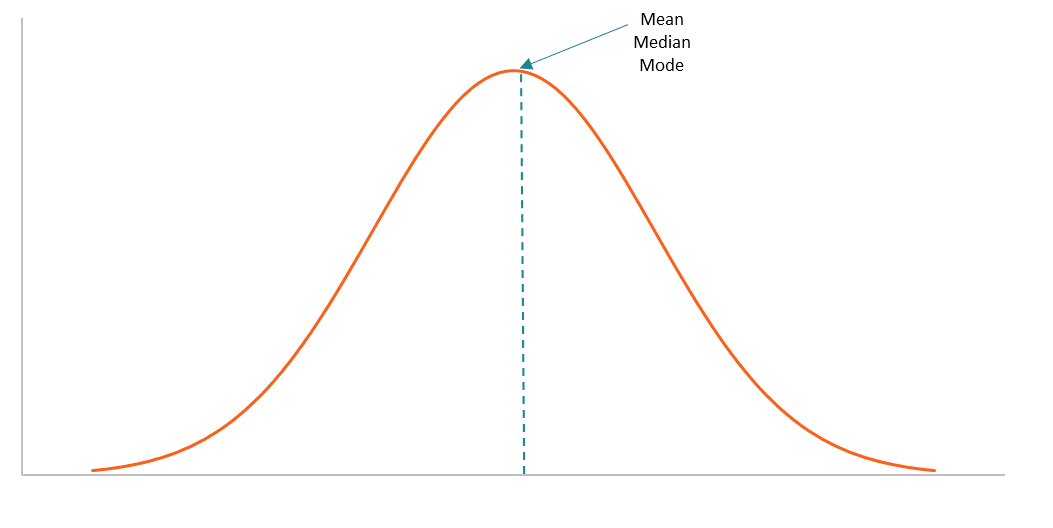
Lies within 1 standard deviation (\(\sigma\)) from the mean (\(\mu\)).
Between \(\mu \pm 1\sigma\): Contains 68% of the total area under the curve.
Lies within 2 standard deviation (\(\sigma\)) from the mean (\(\mu\)).
Between \(\mu \pm 2\sigma\): Contains 95% of the total area under the curve.
Lies within 3 standard deviation (\(\sigma\)) from the mean (\(\mu\)).
Between \(\mu \pm 3\sigma\): Contains 99.7% of the total area under the curve.

Height of Adults:
Using the 68-95-99.7 rule:
68% of adults are between 160 and 180 cm.
95% of adults are between 150 and 190 cm.
99.7% of adults are between 140 and 200 cm.
Real-Life Problems Using the 68-95-99.7 Rule with R